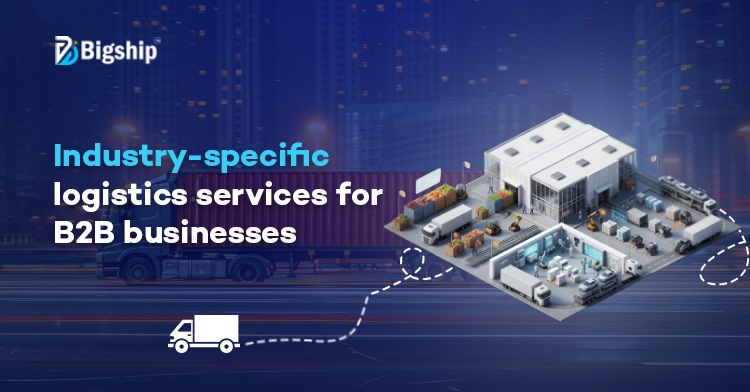
We cannot imagine a business survive without the role of logistics. Especially in the B2B landscape, industry-specific logistics is a game-changer. As there is an increase in the customer’s expectations, the old supply chain is not competent enough against the emerging challenges. This is when industry-specific domestic logistics services come in.

By customizing the logistic operations as per the requirements of different industries, businesses can boost their performance, save costs, improve efficiency, and customer satisfaction. Industries like Pharma, manufacturers, retailers, e-commerce, healthcare, food & beverage, automotive and many more are greatly benefited from this.
Here, through this guide, you will get to know what industry-specific domestic logistics services are, how and why they matter, and how B2B businesses can use them to expedite their growth.
What Are Domestic Logistics Services?
Domestic logistics refers to planning and managing the goods and services of businesses within the boundaries of the nation. It ensures that all functions and processes like warehousing, procurement, inventory, and delivery of business goods, are taken care of. Logistics help in the seamless movement of goods and provide a hassle-free experience across various pin codes.
Difference Between Domestic and International Logistics
| Aspect | Domestic Logistics | International logistics |
| Geography | Limited to only one country | Available in multiple countries |
| Customs and duties | No customs and import & export duties needed | Requires export duties clearance & duties. |
| Transportation modes | Primarily train and road | Road, rail, sea, and air |
Why Do Industry-Specific Logistics Services Matter?
Industry-specific logistics can help businesses in various ways. This provides an integrated solutions to all the requirements of a business, such as aiding businesses in boosting efficiency, helps in compliance, supports cost savings, and ensures reliability.
Benefits of Industry-Specific Logistics Services
- Efficiency: Organized scheduled deliveries save time and prevent all sorts of unnecessary delays. Loading and unloading using advanced equipment cuts the time in half by speeding up the process. Returns and replacements of the goods is done with precision.
- Compliance: As different industries operate under different regulations and frameworks, adhering to the rules and regulations of different industries is very important. Industry-specific logistics ensure compliance with daily activities.
- Cost-savings: Optimum utilization of resources and planned activities reduces futile expenditure, leading to cost-effectiveness.
- Reliability: Consistent, timely deliveries and proven strategies tailored to the needs of the industry win the trust and build reliability. Logistics enable customers track and locate their parcels, ensuring transparency.
Industries that benefit from Industry-specific Logistics
- Healthcare & Pharmaceuticals: – Temperature-controlled storage is provided for temperature sensitive medicines. Insurance of high-value medicines saves you from unnecessary loss.
- Food & Beverage: – Food is delivered in time to preserve its freshness in a controlled temperature. Food safety and regulations are complex, and logistics ensure compliance with it.
- Automotive Industry: – Fast delivery of spare parts and quick and safe handling of fragile things. Special equipment’s used to load and unload of heavy machineries and parts.
- Manufacturing: – bulk transport of raw materials and a customized warehouse for the inventory maintenance leads to productivity in the business operations.
- Fashion & Apparel:- Logistics provide on demand stock of goods required. Keeps the needs of the customers in mind by maximizing the satisfaction level.
Core Types of Domestic Logistics Services
Domestic logistics services form the backbone of supply chains by ensuring smooth movement, storage, and delivery of goods across different business operations. These core services are mentioned below:
- Transportation services: This ensures the timely delivery of goods while offering customized transportation solutions based on product needs, such as technology, pharmaceuticals, and automotive goods. Facilities like temperature-controlled transportation for healthcare shipments and fast-track delivery for urgent consignments further enhance reliability and efficiency.
- Warehousing & Storage Services: This supports businesses in maintaining and storing their ready goods for sales. It manages short term and long term storage, it also provides customized temperature-controlled storage rooms for various goods of different needs.
- Inventory Management Services: These services ensure optimum utility of the stocks and availability of goods.
- Order Fulfilment Services: These services are related to the timely delivery of the goods; they oversee the process of picking, packing, and dispatching the product. They also look after the returns and exchange of the goods.
- Value-Added Logistics Services: Under this service, a product undergoes various improvements, such as labeling, packing, and branding the product for better customer satisfaction.
Key takeaways
- Domestic logistics services offer many features, such as storage, inventory, movement of goods, and delivery of goods to customers within the country. It provides support system to the supply chain.
- Transportation and warehousing are important in relation to this business, but modern logistics provide many other additional supports far beyond the basic movement of goods.
- Inventory management and order fulfillment manage the stock to meet the public demand for goods. While maintaining the customer’s satisfaction.
- It helps save costs by optimizing resources and transportation.
- It provides customized solutions based on the industry’s requirements.
Conclusion
In today’s business environment, logistics is not just a support function anymore. It has a direct impact on how a business functions on a daily basis. When goods move without disruption, daily operational issues reduce significantly. Good planning across transport, storage, inventory, and delivery helps businesses avoid delays, losses, and extra costs. It also makes day-to-day compliance easier, without any constant disruptions. For B2B companies, dependable logistics support brings operational stability, better service standards, and steady progress as the business grows.
What’s the difference between domestic and international logistics?
The main difference between domestic and international logistics lies in the very location where these services are being delivered. Domestic logistics services are available within the boundaries of a country, where the basic mode of transportation is train, truck or ships for small water areas.
What are examples of industry-specific logistics?
Temperature-controlled transportation for the Pharma industries, instant delivery of spare parts in the local area for automotive industries, and safe and protected delivery of technical equipment or tools for the tech industry. These are some examples of industry-specific logistics.
How can logistics improve supply chain efficiency?
Logistics improve supply chain efficiency by proper management of the resources, meeting the demands, delivering the goods in time, at the right destination, and in the right condition.