
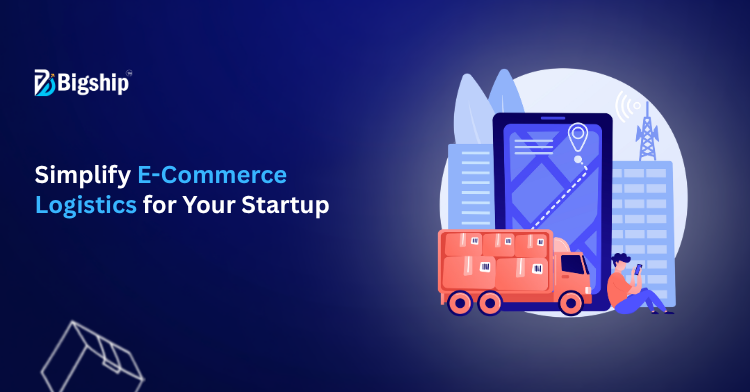
Setting up an e-commerce business is more complex than just selling products on the internet. Managing inventory, order fulfilment, packaging, shipping and handling returns requires efficient processes to be carried out.
And that’s when e-commerce logistics becomes essential.

An appropriate logistics strategy for a startup will help manage expenses, improve delivery performance, minimize failed deliveries and create a positive customer experience. As the number of orders increases, the presence of the appropriate logistics infrastructure will help maintain its level of service.
This guide will tell you everything about e-commerce logistics that a startup needs.
What is E-commerce Logistics?
E-commerce logistics refers to the processes that include storage, management, processing, shipment, delivery and returns of goods sold via an online shop.
They cover the process of transferring products from their suppliers or manufacturers to the warehouse and then to the customers. They also cover reverse logistics, i.e., the process of returning goods to the seller by the customer.
Some key features of logistics in e-commerce are as follows:
- Inventory management
- Warehousing & Fulfilment
- Order management
- Picking & Packing
- Shipping management
- Transportation
- Last-mile delivery
- Returns and Reverse logistics
- Shipments tracking
- Logistics planning
As far as startups are concerned, co-ordination of these functions is very essential due to budgetary and team limitations.
Why is Logistics Important for E-Commerce Startups?
Logistics directly affects the cost, efficiency and customer experience of an e-commerce startup directly. A sound logistics system will make it possible for startups to compete with bigger players and manage fulfilment processes effectively.
Helps to Cut the Cost of Shipping
For an e-commerce startup, shipping is a substantial part of operational expenditure. Selecting suitable couriers, choosing a proper packaging method and comparing shipping costs can be useful in managing these costs.
E-commerce startups can work with multiple couriers to choose services depending on factors such as destination, weight of a parcel, delivery time and availability of courier services.
Improves Delivery Time
Customers increasingly expect faster delivery and timely arrival of their purchases more often.
Effective order processing, strategically located warehouses, automation of shipping processes and reliable couriers are helpful in delivering packages on time.
Improves Customer Experience
It may seem that the customer experience ends when the purchase is made, but order confirmation, delivery notifications, shipment tracking, and return policies affect customer experience as well.
Improves Inventory Management
Proper inventory management ensures that businesses have the right stock levels, without having excess or shortage of fast-moving products.
Good inventory management makes it possible for businesses to know what products are moving faster and plan how best to restock without extra storage expenses.
Improves Reduction in RTO and Delivery Failures
RTO orders make a business incur more shipping expenses, thus making the business less profitable. Some reasons leading to RTO include wrong addresses, delivery failures, unavailable customers, and cancelled COD orders among others.
Good address verification, NDR handling, customer communication, and delivery handling can ensure that startups minimize unnecessary RTOs.
Improves Scalability of the Business
What works effectively at handling 50 orders a day will not work effectively in handling 1,000 orders a day.
Having good logistics processes from the start helps startups handle increased order volumes without changing their processes frequently.
How Does the E-Commerce Supply Chain Function?
The e-commerce supply chain links suppliers, warehouses, logistics, and customers. Although each company may have its own way of functioning, the general flow of operations is as follows.
Product Sourcing and Procurement
The process starts with the sourcing of the product from the manufacturer, wholesaler, supplier, or vendor.
Young companies need to consider reliability, product quality, cost, lead time, and minimum order quantity in order to properly procure the product.
Inventory Management
After procurement, it needs to be stored until the moment when the order will come.
In e-commerce warehousing, products are received, sorted, stored, and managed in order to make sure that the products can be found on time upon the order receipt.
Order Management
Upon the order placement by the customer, the order information is entered into the system and the process of order fulfillment is started.
It normally includes payment verification, inventory check, invoice creation, and order allocation.
Picking and Packing
The products are picked and packed in the warehouse.
The package needs to protect the product while avoiding the usage of excess material and extra packaging.
Shipping & Transportation
Once the packaging process is completed, the package is passed to the courier or transporter.
Shipping management includes choosing courier services, creating shipping labels, arranging for pick-up, and tracking of the shipments.
Last Mile Delivery
The last phase of the delivery process is the last mile delivery in which the package is transported from the delivery point to the customer’s destination.
Since it impacts the experience of the delivery, last-mile operations play a crucial role in e-commerce companies.
Returns & Reverse Logistics
When a customer returns the merchandise, the process goes through the reverse logistics process.
The reverse logistics may include pick-up of the goods, transportation, checking, storing, replacing, repairing, or disposal of the merchandise.
Seven Important Factors That Startups Should Consider for E-Commerce Logistics
There are some important factors that startups may consider before developing their logistics strategy.
1. Forecasting of Demand and Inventory Planning
Forecasting of demand allows startups to calculate the amount of inventory that they will have in stock and its timing.
For this purpose, businesses should consider their sales, seasonal changes in demand, trends in products’ consumption, marketing campaigns, etc., when planning the inventory.
In this way, startups can keep enough inventory in stock in order to satisfy customers’ orders.
2. Supply Chain Visibility
It is important for startups to ensure visibility of their supply chain in order to detect issues immediately.
By tracking inventory level, orders, deliveries, their status, return, etc., businesses can better understand where the problems happen.
It is possible to provide centralized dashboards and other means for monitoring the information.
3. Shipping Costs and Free Shipping
While offering free shipping helps to increase the number of customers, absorbing all shipping costs negatively influences business margins.
For calculating shipping costs, startups need to take into account:
- Weight of packages
- Their dimensions
- Destination of delivery
- Shipping zones
- Cost of couriers
- Charges for cash on delivery
- Additional charges (fuel)
- Last Mile Delivery
Last mile delivery plays a major role in determining customer satisfaction levels.
Founders are advised to analyze courier partners on criteria of delivery range, delivery time frames, first-time delivery success rate, tracking services provided, and region-specific performance.
5. Returns and Reverse Logistics
Returns should not be viewed as something that is to be thought about only at the end of the day.
Clear return policies, easy pickup, efficient inspection, and swift refunding or replacing of goods will make customers feel more comfortable.
At the same time, founders should pay attention to the causes of returns to see what is going wrong.
6. Warehousing and Fulfillment
Founders need to decide where and how their inventory will be kept and fulfilled.
Depending on the order frequency and other needs of the business, startups may opt for any of these ways:
- Self-managed warehouses
- Third-party fulfillment facilities
- Several warehouses
- Dropshipping
- Other hybrid approaches.
7. Logistics Technology and Automation
Technology can automate several repetitive logistics activities.
Depending on their requirements, startups can use technology for:
- Order processing
- Shipping label generation
- Courier selection
- Shipment tracking
- Inventory updates
- NDR management
- Returns management
- Delivery notifications
- Logistics reporting
Automation reduces manual work and can help minimize errors as order volumes increase.
Logistics challenges faced by e-commerce Startups
There are many issues even though logistics is quite important for e-commerce startups when building their logistic system.
Expensive Shipment Charges
Because of low order quantity, the startup will not be able to get favorable prices on them. Together with bulky packaging, the choice of bad courier and long shipment can make the cost of shipping high.
Inefficiency of Delivering Range
Not each courier delivers its goods in all ranges of delivering. If the startup sells their goods in the whole India, they should have more than one courier company.
Problems With Stock Visibility
Visibility problems of stocks can result in stock-outs, stock piling, wrong inventory and late shipments.
Shipment Delays
There may be many reasons of shipment delay: lack of capacity of the courier, bad weather conditions, mistakes, wrong address, or other problems with transporting.
You need to know the status of your shipment in order to contact your clients.
High Return to Origin (RTO) Rate
If you have high RTO rate, you will spend a lot of money on logistics. You should verify the COD, validate addresses and manage NDR.
Management of Returns
Manual return processing can take up a lot of time and effort.
It becomes necessary for startups to implement reverse logistics for handling returns, inspections, refunds, replacements, and inventory adjustments.
Visibility of Shipment Issues
In the absence of visibility, it could be hard to figure out the status of the shipment or what is causing delays.
Shoppers can also keep contacting support for their shipments.
Scalability of Logistics Processes as Business Scales
With increased volumes of orders, manual logistics processes can be cumbersome.
It becomes necessary for startups to implement logistics processes that can manage large order volumes, new products, warehouses, and courier partners without making processes complex.
Effective E-Commerce Logistics Strategy
A well-defined logistics strategy can help startups strike a balance between cost, speed, reliability, and customer experience.
Identify Your Shipping Needs
Firstly, examine your products and your customers.
Some of the considerations include:
- Average order size
- Weight and dimensions of the products
- Delivery location
- Percent of COD
- Expected delivery time
- Return rates
- Seasonality
- Handling needs
All these would define your logistics requirements.
Calculate Shipping Costs
Do not judge shipping based on the face value courier fee alone.
Calculate the total logistics cost based on:
Total Shipping Cost = Forward Shipping + COD Fee + Packaging + Others + RTO/Return Fees
This is a better indicator of the logistics cost for fulfillment.
Select Appropriate Courier Partners
Startups should compare couriers in accordance with their shipping needs.
Some of the factors that matter are:
- Coverage
- Delivery performance
- Cost
- COD capability
- Tracking
- NDR processing
- Returns
Multiple courier partners may also work out well for startups.
Select the Fulfillment Model
Companies can select from self-fulfillment, third party fulfillment, dropshipping or a mix.
It depends on order size, product nature, warehousing need, geography and resources.
Optimization of Packaging
Packaging influences both the product’s safety and the cost of transportation.
Properly sized packaging and absence of additional space should be provided. At the same time, packaging needs to offer the necessary level of protection while the products are being transported.
Provide Shipment Tracking
It is important for customers to know where the order is.
The shipment tracking system allows providing customers with information about the delivery progress.
Creation of the Returns Policy
The returns policy needs to cover eligibility, timeframes, pick up process, refund, exchange and conditions of returns.
A clear policy will eliminate misunderstandings between customers and representatives.
Logistics KPIs Monitoring
Monitoring of logistics operations by startups allows spotting inefficiencies.
KPIs include:
- Cost of shipping per order
- Delivery time
- Rate of on-time delivery
- Rate of first-attempt delivery
- RTO rate
- Return rate
- Order accuracy
- Inventory turns
- Fulfillment time
- Number of customer complaints
Logistics Partner Selection for Your E-Commerce Business
The right choice of logistics partners will have a direct influence on delivery performance and the overall customer experience.
Courier Network Coverage
Ensure that the logistics partner has the capacity to deliver to all those areas where your customers are concentrated.
For companies catering to multiple regions, ensure that the partner covers metro cities, Tier 2 cities, Tier 3 cities, and remote places.
Compare Shipping Charges
Compare charges for different weight slabs and delivery zones.
Also compare any other charges like COD charges, RTO charges, and any other relevant charges.
Performance Metrics
Consider parameters such as on-time delivery, first-time delivery, and RTO performance.
Historical performance will give you a clue about how good the logistics partner will perform.
Technology and Integration Capabilities
Ensure that the logistics platform is able to integrate with your e-commerce store, marketplace, order management platform, or any other business tool.
Real-time Shipment Tracking
Real-time shipment tracking helps businesses and customers track deliveries more effectively.
Consider COD and Remittance Capabilities
Startups catering to customers preferring Cash on Delivery require partners offering COD capabilities.
It is essential to know about the partner’s COD reconciliation and remittance process.
NDR and RTO Management
An effective NDR process can help businesses mitigate the RTO problem by mitigating unsuccessful delivery attempts.
Key features may include notifications, customer communications, re-attempt management, and status update capabilities.
Customer Support
Effective customer support is essential in case of any shipment delays, damages, lost, or undelivered packages.
Scalability
Your logistics partner needs to have the capacity to handle increased order numbers as you grow.
Best Practices in Managing Logistics for E-Commerce Businesses
The logistics operations of startups can be improved by implementing some basic best practices which are as follows:
- Base the logistics planning process on data rather than assumptions alone.
- Keep an accurate record of inventory levels to avoid stockouts and over-stocking.
- Use more than one courier firm when possible.
- Automation of recurring logistics processes to avoid errors.
- Shipment tracking for enhanced transparency.
- Check RTO and NDR performances to spot issues with deliveries.
- Packaging optimization to keep shipping costs low.
- Offer easy returns policy for customers.
- Logistics KPI tracking on a regular basis.
- Use of scalable logistics software for the future.
How can Bigship Assist the Startup Companies in E-Commerce Sector?
The task of handling different courier service providers, managing shipments, tracking updates, COD, NDR, and returns is very complex for start-ups.
Bigship offers an end-to-end logistics platform solution that makes shipping easy for e-commerce companies.
By having access to multiple courier service providers, start-up companies will be able to manage their shipping from one platform itself and make shipping choices as per their requirement.
Some major features are:
- Access to multiple courier service providers for more shipping options
- Smart courier choice as per shipment requirements
- Automated shipping process for less manual effort
- Real time shipment tracking for more visibility
- Helping in reducing NDR and RTO shipments
- Wide serviceability in terms of locations
- Shipping analytics for performance monitoring of logistics
- COD Remittance faster for cash flow management
- Integration with e-commerce platforms for order management
- Dedicated account support for operational assistance
Conclusion
The logistics operations of startups can be improved by implementing some basic best practices which are as follows:
- Base the logistics planning process on data rather than assumptions alone.
- Keep an accurate record of inventory levels to avoid stockouts and over-stocking.
- Use more than one courier firm when possible.
- Automation of recurring logistics processes to avoid errors.
- Shipment tracking for enhanced transparency.
- Check RTO and NDR performances to spot issues with deliveries.
- Packaging optimization to keep shipping costs low.
- Offer easy returns policy for customers.
- Logistics KPI tracking on a regular basis.
- Use of scalable logistics software for the future.
FAQs
E-commerce logistics consists of a series of processes that relate to storing, handling, fulfilling, shipping, delivering, and returning goods purchased via e-commerce channels.
Logistics is very important when it comes to shipment costs, speed of deliveries, stock management, etc.
Shipping costs can be minimized through comparing courier fees, proper packaging, partnering with several courier services, consolidation, efficient inventory planning, and reduction in RTOs and undelivered shipments.
Components of logistics are sourcing, inventory management, warehousing, order processing, picking and packing, shipping management, transport, last mile delivery, shipment tracking, and reverse logistics.
Startups can plan their inventory management with the help of inventory management software, monitoring of stock levels, demand analysis, setting of reorder points, and fast and slow-moving products tracking.
![Read more about the article 10 Best Shiprocket Alternatives in India [2025]](https://blog.bigship.direct/wp-content/uploads/2025/02/shiprocket-alternatives-300x157.jpg)