
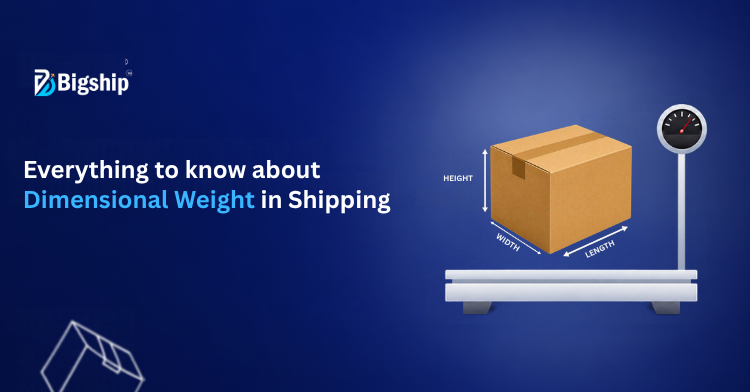
Shipping charges aren’t always about what the box shows on the scale. A large in size but light in weight package can eat up space in a delivery truck, and that’s where volumetric or dimensional weight comes in. Couriers use it to figure out charges based on size, not just weight. A quick calculator can give businesses an estimate by simply entering the box’s length, width and height.

For e‑commerce sellers, getting this right matters. Bulky or lightweight products can rack up costs fast. Knowing how dimensional weight works helps in picking smarter packaging and gives a clearer idea of the real shipping expense.
In this blog, we’ll break down what dimensional weight is, how it’s calculated, and why it’s important for online businesses.
What Is Dimensional Weight?
When you send a parcel, it’s not just about how heavy it is. The space it takes up matters too. That’s what dimensional weight is — it looks at the size of the box along with the weight.
Picture a carton full of cushions. Light as air, but huge in size. A courier won’t charge only for the few kilos, they’ll charge for the space it uses in the truck.
Dimensional weight is worked out using the length, width and height of the package. If that number comes out higher than the actual weight, the courier usually bills you on the higher one.
How Does Dimensional Weight Work?
Dimensional weight or volumetric weight comes in the picture when a box is large but doesn’t weight much. Courier companies won’t just charge you as per the actual weight of your parcel but also for the space it eats up in their truck or warehouse. If the box takes up more room than its weight suggests, they’ll bill you on that bigger number.
It’s worked out using length, width and height with a DIM factor. For example, let’s consider a box that weighs 2 kg but measures large might be charged as 5 kg. In that case, you pay for 5, not 2.
Dimensional Weight Formula
The basic formula for calculating DIM weight is:
DIM Weight = (Length × Width × Height) ÷ DIM Factor
All three measurements are usually taken in the same unit. The DIM factor is the number used by a courier to convert the package’s volume into a billable weight. It isn’t the same for every courier or shipping service, so the applicable divisor can vary.
So, if you’re wondering how to calculate dimensional weight, start by measuring the parcel’s length, width and height. Multiply these measurements and divide the result by the courier’s DIM factor. The figure you get is the dimensional weight, which can then be compared with the parcel’s actual weight to determine the chargeable weight.
DIM Weight Vs Actual Weight
Here’s a list of distinction between dimensional weight and actual weight of a parcel.
| Dimensional Weight | Actual Weight |
| Dimensional weight looks at how much space a parcel takes up during shipping. | Actual weight is simply how much the parcel weighs when placed on a weighing scale. |
| It is calculated using the package’s length, width and height, along with the courier’s DIM factor. | It is calculated by directly weighing the packed parcel. |
| It usually matters when a parcel is large but relatively light. If the dimensional weight is higher, the courier may use it to calculate the shipping charge. | It is generally used for billing when the actual weight is higher than the dimensional weight. |
| For example, a large box may weigh 3 kg but have a dimensional weight of 6 kg. The courier may charge based on 6 kg. | If the same box weighs 8 kg and its dim weight is 6 kg, then charge would generally be based on 8 kg (which is the higher). |
Ways of Reducing Dimensional Weight
A large-sized package can cost you more even when the product inside is quite light. The way you pack makes a big difference.
Use the right size box – Don’t go oversized. Pick packaging that actually fits the product.
Cut empty space – Too much air inside means you’re paying to ship nothing. Fill smart and not excessive.
Pick lighter materials – If the product doesn’t need heavy protection, go for lighter but sturdy packaging.
Review regular shipments – For items you ship often, check sizes now and then. Even small cuts in dimensions can save a lot over time.
Why Dimensional Weight Matters for E‑commerce
Shipping can get pricey fast, especially when boxes are big but light. Couriers charge for the space, not just the kilos, so dimensional weight is something businesses can’t ignore.
Costs go up – Even a light parcel can be billed higher if its size pushes the dimensional weight above the actual weight.
Bulky but light stuff – Cushions, decor, shoes, some electronics-they don’t weigh much but take up much space, so dimensional weight usually is higher than actual weight.
Smarter packaging – Knowing how it works helps businesses avoid oversized boxes and pack tighter.
Clearer estimates – Checking both actual and dimensional weight before shipping helps you see the charges upfront and spot any unusual costs.
Key Takeaways From this Blog
- Volumetric weight is another commonly used term for dimensional weight.
- Courier companies may use dimensional weight when it is higher than the parcel’s actual weight.
- The basic DIM weight formula uses the parcel’s length, width and height.
- Chargeable weight is generally based on whichever is higher: actual weight or dimensional weight.
- Bulky products such as cushions, home decor items and some electronics can be more affected by dimensional weight.
- Using a box that is much bigger than the product can increase the dimensional weight unnecessarily.
- Cutting down empty space inside a package can help keep its size under control.
Conclusion
Dimensional weight isn’t just a side detail — it can seriously change what you pay for shipping. A box that feels light can still cost more if it takes up too much space. That’s why it’s smart to check both the actual weight and the dimensional weight before sending anything out.
A quick volumetric weight calculator helps you see the number in advance. You can pair that with tighter packaging and keeping box sizes under control, and you avoid paying extra for air. For businesses shipping day in and day out, these small checks save real money over time.
FAQs
Dimensional or volumetric weight is based on the space a package takes up, not just what it weighs. Mostly used for big in size but light in weight parcels.
The formula for DIM weight is:
Dimensional Weight = (Length × Width × Height)/ DIM Factor
Actual weight is what the weighing scale shows, whereas, dimensional weight is about how much space the parcel box uses.
It’s just another name for dimensional weight.
DIM factor the number couriers use to turn volume into dimensional weight. Different carriers use different factors.