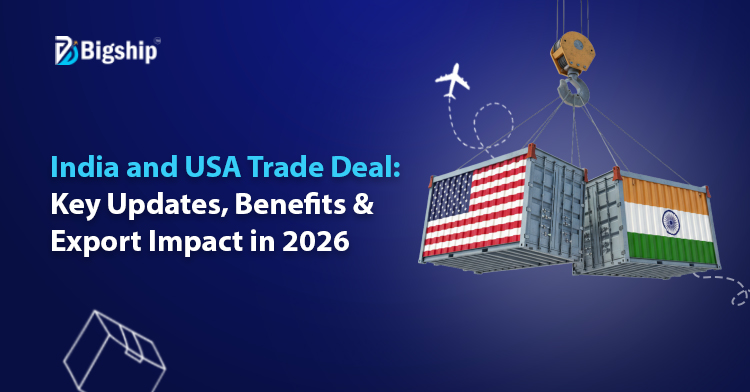
INDIA and USA have gone beyond the traditional way of trading to now maximizing profits bilaterally, enhancing the bond between the two countries like never before. India and the USA have been strong economically good friends.
India exports goods like textiles, pharmaceuticals, and IT services to USA, and imports defence supplies, machines, and advanced technologies. The bilateral trade between both nations has exceeded more than USD 190 billion. Additionally, both nations work together in areas such as investment, technology, defence, and supply chain development, which makes this relationship more than just import/exports.

To encourage this partnership, India and the USA have closed a deal, popularly known as India and USA trade deal 2026, making trade accessible and streamlining the imports and exports. In this blog, we will take you through all the important changes and highlights of this new agreement in detail.
What is the India and USA trade deal all about?
This India and USA trade agreement has simplified the complexities in the trade and has reduced trade barriers to ease out the trading process. Last year, the USA imposed a reciprocal tariff on Indian goods of nearly 50%, which has now been cut down to 18%, and some of the other goods have zero tariffs on them.
This trade deal aims to promote the economic ties between India and USA, alongside achieving other major goals like, expanding the market reach for Indian exporters, Investment and technology from US into India, and services trade.
Why and how is the India-USA trade deal important?
This trade deal is of great importance from economic point of view, as this will boost the strategic partnership and help both the economies grow exponentially.
- The IT service industry in India generates substantial revenue from US clients, which helps to strengthen economic ties between the two countries.
- Trade cooperation helps to support collaboration in other areas such as defence, digital economy, and innovation.
- Many small and medium enterprises in India exports their goods to the US, this helps them gain good profit. USA has a huge consumer market where Indian goods like textiles, gems and jewelry are in huge demand.
- USA investors invest their money in Indian companies and setup their own industries that provides employment and brings FDI.
Current trade volume between India and the USA
The United States is a major importer of crude oil, machinery, and chemicals for India. Our top exports to the United States include jewelry, textiles, gems, and pharmaceuticals. The India and USA trade increased post covid and it amounted to USD 190+ billion in recent years.
There are various sectors and companies that are engaged in ongoing trade with America annually. The following goods are in huge demand in USA:
- Pharmaceuticals
- Textiles
- Electronics
- Engineering goods
- IT services
Key sectors benefiting from the India and USA trade deal
Below given are the key sectors that benefit a lot from India-USA trade.
- Textile & apparel: There exist a huge demand for Indian garments and fabric in the US. A slight drop in the tariff can significantly impact the competitiveness of the Indian goods in the US market against other countries.
- Pharmaceuticals: USA imports a lot of medicine from India as it is quite cheaper for Americans and is a great competitor against other countries like, Singapore, China, Japan. This boosts the demand for Indian medicines.
- Gems & Jewelry: Indian made gold and diamond jewelries, are very popular among the US citizens. The reduction in tariffs will lessen the cost of these ornaments for US retailers and wholesalers.
- Leather, Footwear & Handicrafts: These labor-intensive goods are expected to grow as they were hit by the previous tariffs, and now it is expected to rise again as they rely on US buyers.
- Electronics & Manufacturing Supply Chains: Many Indian companies manufacture aircraft parts and other devices’ parts that US imports. Industries are diversifying and stepping into a variety of products which is leading to more exports to the US.
- IT & Digital Services: This sector may not be directly impacted by lowering tariffs, however, the good relations and stronger partnership encourage the Indian IT services to serve in the US.
What are the challenges in India-USA trade deal?
- Tariff and market-access: The USA is insisting on lowering tariffs on certain goods, such as dairy and agricultural products exported to India. However, to protect its domestic dairy and agriculture sectors, India is not willing to negotiate on these items.
- Regulatory and compliance differences: There is a lot to get done for Indian goods to finally reach the US market. Complex documentations, lengthy rules and regulations, and meticulous quality checks take up a lot of time. This sometimes become a barrier for Indian exporters.
- Implementation: The changed rules on paper can take time to be executed on the ground level, and till then, the business may have to suffer from the same situation. Secondly, the system and procedures have to align with the new changes. Businesses may take time to educate themselves about the new rules.
- Protection of domestic Industries: Both these countries may be vulnerable in some sectors, as the demand for goods that are imported from the other country may threaten their own domestic sellers.
How does the India-USA trade deal impact Indian exporters?
- Lower tariffs: This directly make the Indian goods cheaper in the US, and the demand for the same will also rise. This gives an edge to Indian exporters over their competitor as they can offer a competitive price. This will also help the Indian sellers secure bulk orders and gain a huge profit margin.
- Increased market reach: Good relations will result in trust and reliability between Indian sellers and the consumers of the US. This helps increase the market reach as your business expands to other states of the US.
- Big opportunity for MSME exporters: Small and medium businesses will exponentially benefit as the reduced tariff rates will give access to the US consumers. This boosts the demand for Indian goods and raises the profits for these MSMEs exporters.
- Improved logistics: A good trade deal simplifies complex customs clearance and regulations that help accelerate trade between countries. This also boosts the profits of logistics providers as they work on the front lines and make imports and exports possible.
- New job opportunities: Stronger trade relations often lead to increased foreign investment and joint ventures. US companies looking to expand in Asia may partner with Indian firms.
What are the Documents Required to Export from India to USA?
Here is the list of documents you need to start Exporting.
- Import Export Code (IEC): It is required for customs clearance and foreign payments. It acts as a primary identification number for export transactions.
- Commercial Invoice: This mainly contains the sender and receiver addresses, with the product description and mode of payment.
- Packing List: It describes the contents of each carton, their number, and weight with their dimensions.
- Shipping Bill (India Customs): This is important for customs clearance. It outlines the value and the port of loading of the goods.
- Bill of Lading: The shipping carrier issues this bill that serves as shipment proof and displays the transport contract.
- Certificate of Origin: This shows that goods were manufactured in India.
- Product-specific certificates: There are a few goods that may require special approval from the US. You must have an FDA registration.
What are the major HS Codes used in India and the USA Trade?
HS codes help categorize items that move across borders. This system uses numbers in a uniform way to identify products being shipped worldwide. This is a six-digit number that denotes different kinds of products.
- Textiles & Apparel: USA imports cotton-made cloths heavily, and their HS codes are mainly 6109 and 6205.
- Pharmaceuticals: US imports medicaments (retail pack) whose HS code is 3004.
- Leather & Footwear: HS Code-4202 and 6403
- Chemicals & Plastics: India exports a wide range of chemicals and plastic materials. HS Code is- 2902 and 3824.
- Gems & Jewelry: A major export category from India to the US. HS Code- 7102 and 7113.
How SMEs benefit from the India-USA trade deal?
- Market access: The US market has the largest consumers in the world, and this means that Indian sellers can sell to this valuable customer base and earn a comparatively better profit than domestic sales. Good relations between these two countries will result in better trade relations and expansion into new states and cities across the US.
- Increased cross-border e-commerce: Easy trade flow will encourage small sellers to shift to the online marketplace. US market consumers use E-commerce platforms very often for shopping; this can lead SMEs to earn by selling to international customers with less investment through a D2C setup.
- Collaboration draws innovation: This deal will bring new investment and businesses to India, which will bring new technology and methods of performing tasks. This variation will help Indian companies upgrade themselves and develop for the betterment.
- Access to better logistics: Easier trade deals will lead to more imports and exports. This requires a logistics service provider that facilitates all these operations. Frequent demand for this service forces this industry to be better and more efficient, the warehousing, inventory management and transportation will be affordable and of better quality.
- Growth in export orders: Cheaper Indian goods with lower tariff rates will raise the demand for such goods in the US. This will bring bulk orders and repeat customers to the Indian sellers.
How will logistics industry get impacted by the India–USA trade deal?
- Improved shipping routes and capacity: As trade terms improve, the two countries will strive to find a shorter route for trade to cut down the time of transport. This will bring efficiency to logistics.
- Customs clearance: This usually takes time and may cause delay; frequent trade will make the process faster and smoother. This will boost exports and save time.
- Cross-border e-commerce: With an increase in demand of Indian goods in the US, more goods will be exported from India to US. This will also lead SMEs to switch to e-commerce and connect with their consumers online. To fulfil these demands, logistics will come in handy.
- Competitive cost: Higher trade volumes will directly push the competition among the logistics providers, and SMEs will benefit from this the most by getting negotiated prices, quality facilities and various carrier options.
- Compliance and documentation: Getting the customs clear and getting all the other required documentations is a true struggle. Without these, your exports may face delays and failures on time. To keep this in place, logistics providers ensure accurate documentation and compliance with international trading rules.
The impact of India and USA trade deal in the future
- Trade growth: The recent trade deal has made a lot of difference for Indian exporters. If this partnership continues, India could potentially become a global exporter of many essential goods, and many SMEs can transform into big companies. This will also expand the market reach for Indian sellers.
- Export-led growth opportunities: Geopolitical shift and better trade agreements provide businesses with a chance to explore other options. US companies are moving to invest in Indian companies and sourcing technological experts from here for their work. This will generate employment for Indians.
- Long-term strategic partnership: Beyond trade, the India–USA relationship is expanding into technology, defense, energy, and digital commerce. In future, this is expected to reach new heights from where it will significantly benefit India and help grow globally.
- Supply-chain and investment: The US companies may move to India for sourcing tech employees and invest in Indian industries like manufacturing and tech sectors. The US and India’s collaboration in the electronics, defense, and renewable energy sectors is expected to rise.
Conclusion
The relationship between India and US has been long standing. The agreement and good terms between both are strategically very important as it supports many exporters in India and contributes significantly to the India’s economy. With the passing year, it is expected to grow stronger even more. The US has a huge consumer base, and this can be a great opportunity for India and meet their requirements to dominate the US market.
There is a lot of scope for the country to grow beyond trade. These countries can collaborate in different sectors like pharma, chemicals, defense, and technology. Logistics can improve, and transit time can be short if the trade relations stay strong and stable. SMEs can greatly benefit from this as most of the demanded goods from the US are manufactured by these small SMEs and existing companies. Better trade will also result in attracting foreign direct investment into India.
Key takeaways
- India’s relation with the US is significant economically and geopolitically. It seems to be getting stronger day by day.
- The US is one of the biggest consumer markets in the world where Indians can find valuable consumers for their goods.
- The Indian goods are in demand in the US and is becoming competitive in their market. Now Indian sellers could sell internationally beyond domestic buyers.
- Several sectors from India are in high demand in the US, including pharmaceuticals, textiles, chemicals, and handicrafts.
- SMEs can benefit from e-commerce and D2C businesses.
- Logistics will improve between India and the US, it will shorten the time of transit, and a new direct trade route will evolve to facilitate the trade.