
With today’s rapid advances in e-commerce and logistics operations, customer satisfaction goes way beyond receiving an order. Contemporary customers expect their orders to be delivered accurately, without defects or delays. For companies, effective order fulfillment management is not a minor issue anymore but a key factor in building brand loyalty and increasing revenue.
To measure how effectively an enterprise fulfills those high customer demands, supply chain experts use the metric called perfect order fulfillment. This metric helps assess the entire order lifecycle starting from a customer placing an order and ending with the package being delivered to the customer.
Achieving a high perfect order fulfillment rate can be challenging. Modern logistic systems face various problems like inventory mismatching, inaccurate picking/packing processes, out-of-stock products, shipping damage and manual errors.

This blog will help you understand the order fulfilment process and how to address these issues is crucial for every company aiming to improve order accuracy and overall performance.
What is Perfect Order Fulfillment?
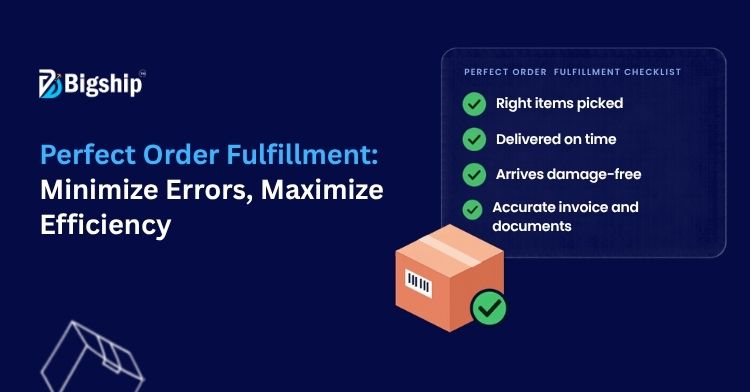
Perfect order fulfillment measures the percentage of customer orders delivered correctly, on time, without damage, and with accurate documentation. An order is considered perfect only when it meets all these requirements.
In supply chain management, it is the ultimate benchmark of customer satisfaction and operational precision. Unlike the conventional assessment that focuses on individual actions such as warehouse operations or delivery speed, perfect order fulfillment considers the result of all these actions taken together:
- Is the right product picked and packed?
- Is it delivered on time (OTD)?
- Is it delivered in perfect condition?
- Are the invoice and other documents accurate?
Ordinary Order Fulfillment vs. Perfect Order Fulfillment
Order fulfilment can be assessed in many ways, depending on whether a business focuses on completing individual stages or meeting all order requirements. The main difference between an ordinary order fulfilment and perfect order fulfilment is given below:
Ordinary Order Fulfillment: The process that concentrates on the successful accomplishment of particular or individual stages of the order fulfillment process without paying much attention to the entire process.
Perfect Order Fulfillment: A benchmark that follows the “all or nothing” approach. An order qualifies as a perfect order only when all four components of the process (accuracy, timing, documentation and product condition) are executed perfectly. Any error, no matter how small it is, will turn the order into an imperfect one.
Which Are the Most Important Factors for Perfect Order Fulfillment?
Several factors determine whether an order qualifies as a perfect order and they are mentioned below:
Order Accuracy
Order accuracy refers to picking and packing all the correct items, including the right variants and color combinations along with the right quantities ordered by the customer. Incorrect picks or wrong product variations mean the order does not meet the requirements for perfect fulfilment.
On-Time Delivery
On-time delivery (OTD) determines if the order has been delivered within the specified timeframe agreed upon by the consumer during checkout. Even a one-day delay can ruin trust and affect performance metrics.
Damage-Free Delivery
It is important that products are delivered in perfect condition. Regardless of the order having been picked accurately and delivered on time, any product damage means the order cannot qualify as perfect.
Accurate Documentation and Invoicing
All documents, including the packing slip, commercial invoice and other shipping documents should be accurate. This helps in avoiding any hold-ups or billing issues.
Order Delivery in One Single Shipment
Order should arrive in a single shipment only (or as agreed by the customer). Split shipments may prevent an order from qualifying as perfect if a single delivery was promised.
Importance of Perfect Order Fulfillment for E-commerce Enterprises
Order delivery is a key factor which directly impacts profitability and brand image of e-commerce companies. Here are some of its key benefits:
- Increases Customer Loyalty and Retention: Customers demand seamless shopping experience. Providing complete, accurate and fast orders contributes to building brand trust and increasing customer lifetime value (LTV).
- Saves on Returns Handling and Shipping Costs: Mis-shipments and damage during shipping can lead to higher returns handling costs, additional shipping costs and extra labor involved in restocking. A perfect order fulfillment saves you from this situation.
- Improves Supply Chain Visibility: Monitoring perfect order performance reveals unseen inefficiencies within the order management process, thus providing opportunities for improvement.
- Brand Image Protection: With online reviews and customer feedback readily available, order mistakes quickly impact the reputation of the company. Hence, a perfect order fulfillment helps protect your brand image in the market.
How to Calculate the Perfect Order Fulfillment Rate
The perfect order fulfillment rate represents the percentage of orders delivered without any errors in the fulfillment process.
The formula is:
Perfect Order Fulfillment Rate = (Number of Perfect Orders ÷ Total Number of Orders) × 100
In this calculation, a perfect order is supposed to meet all of the requirements such as order accuracy, complete delivery, on-time delivery, undamaged delivery and accurate documentation.
Example:
Let’s assume that an e-commerce company handles 2,000 orders within a month. Out of these, 1,760 orders meet all the requirements of a perfect order.
Perfect Order Fulfillment Rate = (1,760 ÷ 2,000) × 100
Perfect Order Fulfillment Rate = 88%
Thus, 88% of the orders delivered by the company are perfect orders.
The other 12% of the orders faced at least one problem such as delay in delivery, an incorrect order item, an incomplete order, product damage or documentation error.
Typical Problems That Hindering Perfect Order Achievement
In order to have a very high perfect order fulfillment percentage, it is necessary to overcome many barriers that always exist in the order fulfillment process:
Inventory Discrepancy and Stockouts: The mismatch between WMS and actual stock levels can lead to inaccurate inventory records, order cancellations, split shipments and delivery delays.
Order Fulfillment Errors: When employees rely on a manual pick list, there is a possibility that they may pick the wrong sizes, quantities or accessories.
Carriers’ Delays in Delivery: Bad weather conditions, heavy traffic, peak time charges, and bad routing can result in carriers’ failure to deliver on promised OTD windows.
Improper Packaging and Cargo Damage: When there is improper use of box sizes, inadequate use of dunnage (bubble wrap, air pillow), or improper packaging, goods may get crushed or damaged in transit.
Manual Process and Documentation Errors: Manual typing of addresses or improper labeling of customs manifests might cause rejection by carriers, wrong billing and customs hold.
No Visibility of Shipments: Without proper tracking of the whole shipment process, logistics teams will not be able to foresee and take preventive measures for any possible transit issues.
Seven Ways to Increase Perfect Order Fulfillment
Businesses can improve perfect order fulfilment by making a few key improvements across inventory management, warehouse operations, shipping, and order processing.
1. Better Inventory Management
Ensure real-time inventory synchronization with sales platforms through the use of inventory management software. Incorporate routine cycle counting and the use of safety stock levels to avoid stockouts and backorder situations.
2. Warehouse Strategies
Consider using warehouse strategies like zone picking, batch picking or wave picking. The employees within the warehouse can be equipped with handheld barcode scanners or RFID devices for automatic SKU validation before putting the item inside the shipping carton.
Effective warehouse slotting can also help businesses organize product locations, reduce picking errors, and improve warehouse efficiency.”
3. Order Automation
Use order management systems (OMS) that automate the order process instead of relying on manual processes. Order automation also ensures that the order passes from the point of checkout to the nearest fulfilment centre in an error-free manner.
4. Partnering with Efficient Logistics Providers
Partner with logistics providers and carriers that have good OTD benchmarks. Having multiple carrier options and multi-carrier shipping software helps ensure that the ideal carrier is automatically selected.
5. Implement Real-Time Tracking of Shipments
Implement real-time tracking solutions for informing your operations team as well as the buyer about the progress of the parcel. This makes it possible to address shipment exceptions promptly.
6. Standardize Documentation and Inspections
Standardize the pre-shipment inspection process and automate invoicing. Develop visual guides for the packaging process and use automated weight checks for cartons.
7. Measure Fulfilment KPIs Continuously
Measure operational metrics continually and not quarterly. With continuous monitoring of performance metrics, the operations manager will be able to identify bottlenecks and trends easily.
The Metrics You Should Be Tracking for Perfect Order
Companies should track a set of metrics to evaluate the impact of various factors on the fulfillment process. Each metric will help identify certain areas of performance.
1. Perfect Order Fulfillment Rate
The perfect order fulfillment rate shows the share of orders which were sent out without any problems according to all of the fulfillment requirements.
Formula:
Perfect Order Fulfillment Rate = (Number of Perfect Orders ÷ Total Orders) × 100
It is the main indicator of the performance of fulfillment.
2. Order Accuracy Rate
The order accuracy rate shows the percentage of orders with the correct products, quantities and specifications.
Formula:
Order Accuracy Rate = (Correct Orders ÷ Total Fulfilled Orders) x 100
A high order accuracy rate means that the order fulfillment and warehouse management processes are carried out properly.
3. On-time Delivery Rate (OTD)
On-time delivery rate measures the percentage of orders delivered within the promised timeframe.
Formula:
OTD = (Number of Orders Delivered on Time ÷ Total Delivered Orders) × 100
High OTD is the indicator of effective delivery performance. Companies need to consider their delivery timeframes consistently.
4. Order Fill Rate
The order fill rate is a performance indicator of how well a business meets customer demand using available stock.
It can be calculated using units in the following way:
Order Fill Rate = (Units Fulfilled Immediately from Available Stock ÷ Total Units Ordered) x 100
It usually means that the company has higher inventory levels if the order fill rate is high. Companies should state whether the metric is calculated on the basis of units, order lines or orders since the results will differ.
5. Order Cycle Time
Order cycle time is used to assess the time required to fulfill an order from the start of the process to its completion.
For instance, it can be the time between order placement and delivery of the product to the customer.
Formula:
Order Cycle Time = Order Completion Time – Order Start Time
6. Return and Damage Rate
It is the metric indicating what percentage of orders were returned or reported as being damaged within a specified period of time.
Formula:
Return and Damage Rate = (Orders Returned or Reported Damaged ÷ Total Orders Shipped) × 100
Firms need to specify the criteria used to calculate return and damage rates and make sure orders that fall into both categories are not counted twice.
An increasing rate may be caused by various factors including defective packaging, poor product quality, wrong shipments, or ineffective delivery handling.
7. Shipping Exception Rate
The shipping exception rate indicates the rate of shipments subject to specified delivery or transportation exceptions, including address issues, failed delivery and any other unexpected delay of shipments.
Formula:
Shipping Exception Rate = (Shipments with at Least One Qualifying Exception ÷ Total Shipments) × 100
An increasing shipping exception rate suggests that there may be issues related to address accuracy, carrier performance, or delivery planning.
Thus, these metrics, when considered together, can help a firm get a more complete picture of its fulfilment performance.
How Shipping and Logistics Partners Help Improve Order Fulfillment
When the in-house order fulfillment process is scaled up, it can become challenging to manage unexpected increases in order volumes or expansion into new geographical areas. The collaboration with professional Third-Party Logistics (3PL) firms and fulfillment companies can simplify this process as follows:
- Distributed Fulfillment Network: Holding inventory in regional centers helps speed up shipping since proximity to end users decreases delivery time and minimizes shipping costs.
- Technology Inclusion: Leading 3PL providers use automated warehousing technology, automated inventory routing and automated packaging systems to prevent human errors.
- Carrier Network: Professional logistics companies have robust carrier network and offer volume discounts that help in maintaining on-time delivery OTD performance during peak seasons.
- Order Surges Management: Specialized fulfillment companies help manage the increased order volumes successfully.
Conclusion
Perfect order fulfillment performance is an important differentiator for modern e-commerce and logistics companies. Accurate and complete order delivery without damage or delays helps to build customer loyalty and avoid additional costs connected with handling returns.
In order to increase your company’s perfect order fulfilment rate, you should improve all steps of order management – from implementing real-time inventory management systems and automating warehousing operations to selecting dependable carriers and monitoring metrics such as OTD.
FAQs
Perfect order fulfilment is an important supply chain indicator measuring the percentage of orders delivered to the customers without mistakes. For an order to be considered perfect, it should be complete, with the right items, on-time (OTD), undamaged, and with accurate documentation and invoicing.
It affects their customers’ satisfaction level, repeat purchases, and overall reputation. Perfect order fulfilment helps reduce costs associated with returns processing, reshipping and customer service.
These key variables are accuracy of inventory management, accuracy in picking and packing, carrier performance, quality of packaging, accurate documentation, and complete visibility during the shipping process.
Companies can increase order fulfillment accuracy by introducing barcode scanners in the warehouse, automation of order handling process, regular cycle counting, implementing standardized quality checks, and using an advanced warehouse management system (WMS).
Order accuracy is the measure of whether the correct items and quantities are included in an order, while perfect order fulfillment is the measure of entire outcome of the fulfilment and delivery process, including order accuracy, damage-free delivery, on-time delivery and accurate documentation.