Sending your order to customers can involve a number of factors. For example, when you send your order to a courier partner you must take into consideration the delivery location, delivery cost, time frame, and courier availability and performance.
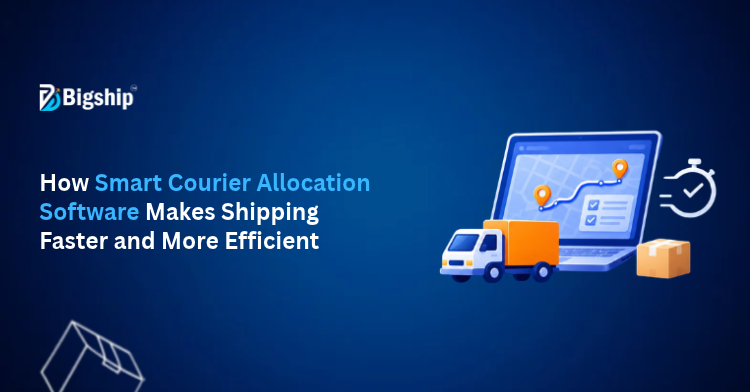
By using courier allocation software you will be able to find the best courier partner for your shipments based on certain rules, serviceability, delivery speed, and delivery cost.
By using a courier allocation system you won’t need to manually search for the best courier partner option for your order. This will save you time, keep your shipping processes more organised and will make them much easier to manage. Especially if you have lots of orders to send everyday.
What Is Courier Allocation Software is an automated tool used for shipping. It helps you easily allocate your shipments to the right courier partners based on your specific needs. It will look at the shipment details, delivery location, courier availability, delivery cost and other factors and then recommend or allocate a delivery partner.
If you work with multiple logistics partners then it will help you easily manage your multi-courier solution.

Why Is Courier Allocation Important For E-Commerce & Logistics Businesses?
Different couriers will offer different levels of service depending on the location. For example, one might offer quicker delivery times in metro areas and another might offer better serviceability in small towns.
Choosing the right courier partner will help you:
- Keep your delivery costs down
- Ensure your orders are delivered in the correct time frame.
- Improve your delivery success rates.
- Minimise delivery failures and RTOs.
- Ensure a consistent customer experience.
Automated courier allocation will help simplify this process by looking at the available courier options.
Why Manual Courier Allocation Can Be Problematic
If you only have a few orders to send everyday then manually choosing your courier partners may not be too bad. However, if you have a large amount of orders to send then this can become quite complex.
Finding out which courier has the best rates, pin code serviceability and delivery times can take up a lot of time. This can also cause human errors.
Some common problems include:
- Time-consuming operations: Teams have to check multiple courier options before assigning shipments
- Increased delivery costs : If you aren’t comparing the right courier rates then you may be sending your orders with an expensive courier service.
- Hard to see courier performance : It can be difficult to manually track how well each courier is performing based on the location.
- Inconsistency : Different members of your team may use different methods when choosing which courier to use.
- Slow dispatch processes : Allocating couriers manually can slow down your dispatch process especially during busy sales and festive periods.
By using a courier selection tool you can eliminate these by automating the repetitive processes and ensure you are consistently allocating the right couriers.
How Does Courier Allocation Work?
A courier allocation system will follow a process to ensure that the best delivery partner is selected. Each system may vary slightly but most will follow this process:
1. Automatic Order & Shipment Information Capture
Your order will come in via an e-commerce site, marketplace or other sales channel.
The software will then capture key shipment information including:
- Pickup & Delivery Pin Code
- Weight & Size
- Value
- Payment Type (COD or Prepaid)
- Product & Shipment Type
2. Map Out Courier Partners & Serviceability
Once you have the shipment information the system will find out which courier partners can deliver to the delivery pin code.
It will look at the pickup availability, delivery coverage and serviceability of each courier. Only the valid options will be moved onto the next step.
3. Rule-Based Assignments
Customers can build rules that dictate to whom they should assign couriers.
For example, they can assign to an ideal courier for deliveries to the metro and/or a cheaper option for non urgent shipments.
This will help to ensure a standardized process.
4. Cost Bases and Fast Delivery Offers
An automatic system will consider the different couriers and identify the best option based on the posting cost, expected delivery times and courier performance. This will help business achieve a good balance between quick delivery and reducing costs.
5. Assign and Track Products
Once the right couriers have been selected products can be assigned, generating the required document for postage such as AWB numbers or postage labels. Depending on what the platform can offer, you will then be able to track couriers.
6. Monitor and Optimize Couriers
You can monitor the performance of your couriers. By using data such as delivery success rate, delivery times, RTO rate.
Understanding how well the different couriers perform will assist you by highlighting which ones will perform better for specific locations and shipments.
Things To Consider When Choosing Your Couriers
When choosing a courier it can sometimes be a bit more complicated than just considering the cheapest shipping options.
There are a few things to take into consideration to ensure your shipments arrive safely and on time. Consider the following:
- Delivery Coverage and Pin Code Coverage – Does the courier cover the delivery location?Do they offer a pickup service?
- Postage Costs – What is the postage cost? Are there weight bands and extra delivery charges?
- Expected Delivery Times – How long will the items take to deliver? Will they meet customer expectations?
- Performance – How well do they deliver? How often are their late? Do they have high RTO rates? How do they perform in different locations?
- Weight, Size and Type – Do they offer services for your shipment?
- COD/Prepaid – Do they offer the correct payment options? Do they offer suitable COD times?
Overall understanding these will help you choose the most suitable couriers and avoid any unnecessary complications.
Benefits Of Using An Automated Courier Assignment
There are several benefits to using an automated courier assignment system, especially if you run an e-commerce company that has lots of couriers and shipments.
1. Save Money On Postage Costs
Your postage costs can be expensive if you do not compare your couriers. The courier assignment will help you by identifying the best rates and helping you get the best value for money.
2. Faster Order Processing
If you are manually choosing your couriers this could slow down your shipping process. The automated system will help reduce repetitive tasks by automatically assigning your couriers. The couriers will be those that are suitable based off the rules set.
This ultimately means your orders will be processed quicker.
3. Increase Delivery Success Rate
Choosing your couriers based on coverage and performance will increase your chance of your products being delivered.
For example, you can prioritize your couriers that have better delivery performance in certain pin codes.
4. Reduce RTO
RTO is when a product cannot be delivered successfully.
Whilst this cannot be completely avoided through choosing your couriers. Choosing reliable couriers based on their performance in locations, coverage and COD will help reduce any avoidable delivery issues.
5. Manage Multiple Couriers Easily
Managing multiple couriers can become a complex task.
An automated courier assignment system will help manage your multiple couriers easily. You can easily manage your couriers, rules and assign shipments all in one place.
6. Improve Customer Experience
Customers expect fast deliveries and are always looking for delivery updates. Choosing the correct couriers will assist with providing a more consistent delivery experience.
Having fewer delays, better delivery performance and consistent tracking will help to improve customers confidence.
7. Improve Efficiency
By reducing the manual input required to help your logistics team focus on other key areas. This will improve efficiency.
When Should Businesses Use A Courier Allocation Tool?
Whilst automation may not be required for all businesses, courier allocation can become complex as more shipments are being delivered.
Businesses should invest in courier allocation tools if:
- They are sending a higher volume of shipments daily.
- They have multiple courier partners.
- They are finding it hard to control costs of shipping.
- Manual allocation is causing delays to order processing.
- They are experiencing different delivery performance per pin code.
- They want to automate their shipping processes.
E-commerce brands looking to scale can benefit from using logistics tools with courier allocation functionality.
How Courier Allocation Software Helps With Last Mile Deliveries
The last mile is the final stage in the shipping process. This is when the order is sent to a local delivery hub and then to the customer. The last mile is often one of the most challenging parts of logistics due to many factors affecting delivery performance.
Courier allocation tools can help to optimise last mile delivery by allowing you to select the best delivery partners.
For example, if you frequently get better performance from one delivery partner in a certain area, the tool will allow you to select this delivery partner.
Courier allocation tools can help you:
- Select the best delivery partner for your region.
- Avoid sending shipments to areas which are unavailable.
- Faster deliveries by selecting the best courier.
- Understand areas where deliveries are not performing well.
- Make smarter decisions with your allocation by using shipment data.
With tracking tools, NDR and delivery analytics, courier allocation is a key component of more efficient last mile deliveries.
How To Choose The Correct Courier Allocation Tool For Your Business
To choose the correct tool for your business, you need to understand your shipping requirements.
Consider these points:
1. Multiple Courier Partners: Ensure the platform supports your regular courier partners.
2. Automate Allocation Rules: Choose a tool with flexible rules to allocate based on pin code, rates, delivery time and shipment requirements.
3. Serviceability Checker: The tool should help identify what couriers are available for each delivery.
4. Compare Rates: Compare the rates of your available couriers to help minimise your transport costs.
5. Analytics: Choose a tool with analytics to help understand how well deliveries are performing.
6. Integration With E-Commerce Platforms: Ensure the tool integrates with your website, marketplace, or current order processing.
7. Scalable: Choose a scalable tool to help with increased shipment volumes.
Choose a tool which will help reduce the complexity of selecting the right courier. Ensuring there is enough flexibility to adapt to your changing shipping requirements.
Conclusion
Efficiently managing your courier partners can help you keep costs of shipping in check. As order volumes increase, it can become time consuming to manually select the right courier partner.
Courier allocation tools can help simplify this by automatically selecting the right courier partner based on serviceability, rates, delivery time and performance. Whether you have rules set up or use AI, courier allocation tools will help you make better decisions.
By using the correct shipping automation tools, you can help streamline your order processing, improve your courier management and create a more efficient delivery network.
FAQs
A digital tool to help businesses choose the best courier partners for their shipments. This will take into account delivery location, serviceability, rates and estimated delivery time.
The tool will gather shipment information, identify which couriers are available, look at the available delivery options and select the best courier partner based on your rules or data.
You will save on shipping costs, orders will be processed quicker, delivery performance will improve, it will be easier to manage multiple couriers, reduce manual work and improve customer experiences.
This tool will compare your available couriers, based on the rates, weight, size and delivery requirements to ensure you are choosing the most cost effective option for your eligible orders.
Yes, it will help to reduce avoidable RTO by selecting the best performing delivery partners. However, RTO will also depend on incorrect addresses, customers not being available and order refusals.
Key factors to consider are serviceability of the destination, rates, delivery time, reliability of the courier, weight and size of the shipment and whether it is COD or prepaid.
Rule based allocation will use rules set up by the business. AI based allocation will use data and predictions to calculate the best option. AI based tools may pick up patterns in deliveries to help with more adaptable decisions.