Communication has a big part to play in logistics industry. Businesses have to make calls to their customers, delivery agents and other teams for a variety of reasons. It could be about updating on the delivery of shipment, sometimes it could be about a parcel being delayed or when the customer is not available to receive the final delivery of shipment.

And here, AI calling has a prominent role to play in logistics. It can do things like making repeated calls, share information about the delivery, and also collect the responses of customers.
This blog will take you through the prominent use cases of AI Calling, benefits, and applications in the logistics industry.
What’s AI Calling in Logistics Industry?
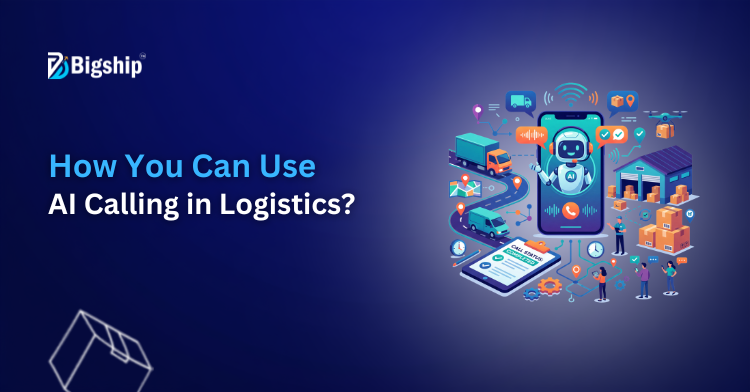
AI calling in logistics simply refers to the usage of automated calling systems which can make calls and talk to people on behalf of humans. It uses artificial intelligence or AI to communicate and share information with the customers.
Well in logistics these AI voice agents can take care of conversations related to parcel delivery, shipment status, customer availability and delivery confirmation. Also to make it more humanized they can also ask questions and collect responses from customers or delivery staff.
These systems have the immense capability of making multiple calls, then understanding basic replies and also are given training to respond accordingly. So, instead of staff making the same calls again and again, AI calling can take care of such regular communication work.
Key Use Cases of AI Calling in Logistics
You can use AI calling for various types of communication work in logistics. Below are some of the common use cases:
1. Calls for Order Confirmation
As soon as a customer places an order, the business or the store may need to confirm the authenticity of the order whether it was an actual order or not. So through AI calling agent, companies can make confirmation calls to the customer asking whether they placed the order. The customer can reply through the call and the system records the response. This also helps sellers identify orders where customers are not sure about their purchase.
2. Verification of COD Orders
With COD orders, there are when customers might refuse to accept the parcel during the delivery time and this is a problematic thing. Through AI calling you can contact the customer before shipping the order and ask if they are ready to pay the amount at delivery. If the customer confirms, the order can move ahead for further processing and also gives sellers an idea about doubtful orders.
3. Scheduling of Pickup and giving Reminders
In cases where seller is not available or the shipment is not ready at the stipulated time, the pickup gets delayed. Here also, AI voice calling can remind the sellers about the pickups of the shipment and also ask if the shipment is ready. The system can also share pickup-related information so that sellers and delivery teams are not left waiting for updates from each other.
4. Updates on Shipment and its Delivery
Usually what happens, customers keep asking about their parcels, especially when they find that shipment is taking longer than expected time. AI calling systems can provide updates about shipment movement, delivery status or possible delays rather than just depending only on manual call.
5. Confirmation on Delivery Availability
Sometimes the customer is not available to receive the parcel when the delivery agent may reach their location. This creates another delivery attempt and wastes time as well as money. So, through AI calling, first of all the customer can be contacted and asked whether they will be available to receive the delivery of the shipment. Based on their response, the delivery team can plan the next step.
Bigship’s AI Calling Assistance Feature
Bigship has also taken a step toward the implementation of AI for calling however this feature is a little different from regular shipment update calls. First of all this feature is known as Bigship AI Calling Assistance and it helps sellers and businesses to use AI calls for their various marketing activities and customer communication.
Let’s understand this with an example, suppose you are a seller and you want to run a Diwali campaign where you want your customers to know about exclusive deals you are planning to offer to them. Since during festive time, especially Diwali businesses are already packed, this type of activity require extra bandwidth so here they can use Bigship’s AI Calling Assistance. Simply you have to upload the list of your customers and generate a script which further is refined by the system then the system makes calls based on the given instructions and collects responses. Sellers can use the campaign data to check how customers responded. This reduces the need to make every marketing call manually.
Benefits of AI Calling in Logistics
There are numerous benefits of AI calling for logistics businesses, especially when you have to make too many calls every day.
- AI calling can easily make calls to customers and also to sellers (depending on the requirement) without waiting for a person to become free. It can also share basic information quickly and get replies also. This faster communication helps when there are many orders and communication needs to happen on time.
- It takes a lot of time making calls one by one and especially when the same type of information has to be shared with many customers. AI calling in such cases reduces this work of making repeated calls and the staff can use that time for other tasks.
- Customers do not like waiting for shipment information, you as customer wouldn’t too. Here you can utilize the AI calling to can share pickup reminders, delivery updates and other important details through calls. In this way, your customers get information without having to contact the seller or support team every time.
- The Logistics industry involves sellers, customers, delivery agents and other stakeholders. If communication is compromised and not proper, then even small issues can turn into delays. Thus, AI calling helps each stakeholder get basic updates and confirmations, which makes coordination a little easier.
Conclusion
In the nutshell, the AI calling feature in the industry of logistics is becoming useful. Every business has to make many calls on a daily basis. It could be order confirmation, updates on pickup, then COD order confirmation, availability during at the time of delivery, and the list is on. AI can manage such repetitive tasks removing burden from the team who don’t have to sit to make these small calls.
Still, AI calling is not only about making calls faster as it also allows businesses stay connected with customers, sellers and delivery teams or whichever stakeholder is involved. Its use can increase as more logistics operations start using automation.
FAQs
AI calling in logistics is nothing but the usage of the artificial intelligence in making calls that can communicate with customers, sellers, delivery teams or whichever stakeholder involved. It can make calls and share information without a person handling every call.
There can be many usecases where one can deploy AI voice agents to talk to people over phone calls. For example they can ask questions, give information and collect responses based on the conversation or whatever instructions they have been fed upon with.
Yes, AI voice agents can be trained and used to make bulk calls to multiple customers using an uploaded call lists and the prepared instructions.
Yes it is useful for sellers. As a seller you can use AI calls to confirm if customers have actually placed a COD order and are ready to receive it during the delivery. This may help identify customers who are not interested in accepting the parcel and save you from spending money on shipping.
No, this is not true. AI calling does not completely replace human customer support but help them shed some load off their shoulders. It can handle regular and repeated conversations, but complicated customer issues may still require a human agent.