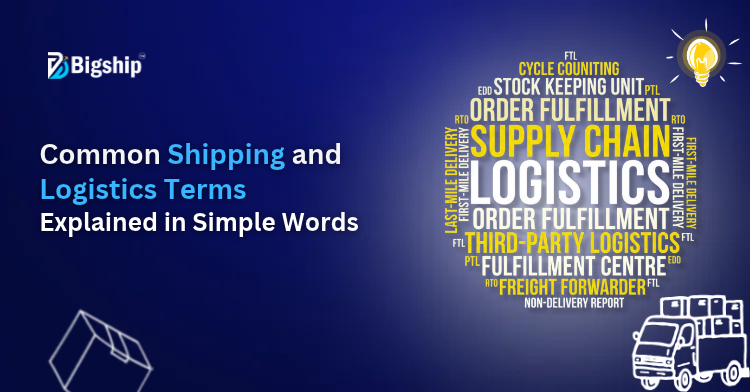
Shipping and logistics involve several terms that businesses encounter when managing orders, transporting goods and handling deliveries. From freight and order fulfilment to FTL, PTL, NDR and RTO, understanding these terms helps businesses communicate more effectively with logistics providers and manage shipping operations.
In this guide, we’ll explain common shipping, logistics and supply chain terms, along with their meanings and practical examples.

Basic Logistics and Order Fulfillment Terms
So, before we get into other common shipping terms, let’s first talk about some basic logistics words. You might have heard these terms quite a few times and if you run an online business or deal with product deliveries then definitely you might be aware of them. But what do they actually mean? Let’s see.
Logistics : Logistics is all about how products move from one place to another. That’s the simple meaning. But there are other things also involved here, like where products are kept, how they are packed, who will transport them and how they will reach the customer. For example, if you sell clothes online, getting those clothes picked up, packed and delivered comes under logistics.
Order Fulfillment : Now, this is something every online seller should know. Order fulfillment is the process that starts as soon as the customer places an order subsequently, they have to check the order, then find the product in their inventory, if they find it, then pack it and arrange its delivery. And that’s not all. The order also needs to reach the correct customer. So, all these activities together are comprise of order fulfillment.
3PL ( or Third-Party Logistics) : Let’s understand with a scenario, suppose you don’t want to manage storage, packing and shipping by yourself due to any reason. In such cases, you can take help from a third-party logistics provider or 3PL. The provider handles most of your logistics work.
Fulfillment Centre : A fulfillment centre is a place where products or items are to be sold are kept until someone orders them. As the order comes in, that product will be picked, then it will be packed and finally sent for delivery.
Supply Chain : You can think supply chain as a vast process and logistics is part of it. It covers the complete journey of a product – Like where the raw material comes from, who made the product, where it was stored and how it finally reaches the buyer.
Inventory and Warehouse Management Terms
Now, let’s peep into some warehouse terminology. These terms are usually related to how products are stored, monitored and prepared before the shipping happens. If you have a business that sells products, you will probably come across these terms quite often.
SKU (or Stock Keeping Unit) : In warehouse each product has a designated unique code for easy identification and this code is called SKU.
Inventory Management : Inventory management is simply keeping track of how many products are left in the warehouse, what are the items that are selling and when you need to order more stock.
Picking and Packing : Picking is taking of the ordered item from the storage place in the warehouse, whereas, packing comes subsequently, where the same product is packed properly before shipping it.
Kitting : Kitting is something which many might not have heard, however, it the process when two or more products are packed together and sold as one set. For example, a skincare kit with face wash, moisturiser and sunscreen are all different but since they are ordered in a combo pack so they are packed as signle unit.
Cycle Counting : It means checking a small portion of warehouse stock regularly instead of counting everything at once and this practice helps e-com businesses find stock differences and keep their inventory records updated.
Shipping and Transportation Terms
There are many Logistics terms and definitions that you may hear while booking shipments or dealing with courier companies. Some are related to the type of transport, while others tell you how goods are moved from one place to another. Let’s check a few of them.
Carrier : A carrier is simply a company that picks up and transports your shipment through various modes of transport.
Freight : People are often confused with the word “Freight”. It means goods that are transported from one place to another and is used for huge shipments or goods that are transported in bulk.
FTL (Full Truckload) : When you book the entire truck for its shipment, meaning that entire space inside the truck is yours.
PTL (Part Truckload) : When the shipment takes only a part of the truck space, and other goods can be transported in the same vehicle. It simply means when your shipment shares space with other people shipments.
Air Cargo : When goods are transported from one place to another through aircraft, it is called air cargo. Businesses mostly use this option when they need faster transportation, especially for long-distance or international shipments.
Road Freight : When a shipment is transported via road then it is called road freight.
Freight Forwarder : A freight forwarder is a person or company or entity that arranges the transportation of goods for you and help with things like booking cargo space, documentation and coordinating with carriers.
Delivery, Tracking and Shipment Status Terms
As the parcel leaves the warehouse, you’ll see that there will be different updates that sellers and customers get. You may have seen some of these words while checking an order status. Here is what they mean.
Order Processing : Order processing commences as soon as a customer places an order. The seller checks the order, confirms product availability and gets it ready for dispatch.
Order Dispatch : When the packed order leaves for delivery from the seller’s warehouse or facility, it is called order dispatch.
In Transit : You will get to see this status when your parcel is on its way to the delivery location. It may move through different hubs before reaching its final destination.
Last-Mile Delivery : This is the final or the last part of the delivery process. The shipment moves from the local delivery hub to the customer’s doorstep.
First-Mile Delivery : As the name says it is the initial movement of a parcel from the seller’s location to the logistics network.
Estimated Delivery Date (or EDD) : EDD is the date on which a customer can expect their order to arrive. It is just an estimated date, so the actual delivery may sometimes take longer.
Proof of Delivery (POD) : POD is a confirmation document that says the parcel has been delivered. It can be a photo, signature or digital confirmation of delivery.
NDR (Non-Delivery Report) : This is generated when a delivery attempt fails and this report usually mentions the reason, such as the customer not being available or an incorrect address.
RTO (Return to Origin) : RTO happens when a parcel is sent back to the original pickup location instead of reaching the customer. And reason could be any whether after failed delivery attempts or other delivery issues.
Conclusion
So, these were some common shipping terms and definitions that businesses should know about. Logistics, honestly, have much more terms and not each of them are easy to understand at the first glance. However, if you are dealing regularly with warehouse work, shipping and deliveries, they become quite familiar. Knowing basic Supply chain terminology also helps you understand how different activities are related to one another.
Still, knowing these terms is one thing, and managing shipments is another. You also need a reliable logistics partner for your business.
FAQs
Shipping terms and definitions are those words that are used in the logistics industry. These can be freight, carrier, dispatch, COD, RTO, FTL and PTL, which explain different shipping activities.
Some basic logistics terms that are used in day to day life are: supply chain, order fulfillment, inventory management, freight, carrier, warehousing and last-mile delivery.
Logistics mainly deal with storing and moving products from one place to another. When we talk about supply chain, it covers a bigger process (including logistics), starting from raw material sourcing to manufacturing and final product delivery.
FTL means Full Truckload, i.e., you own the entire truck space. PTL means Part Truckload, where your goods occupy only some space in a truck.