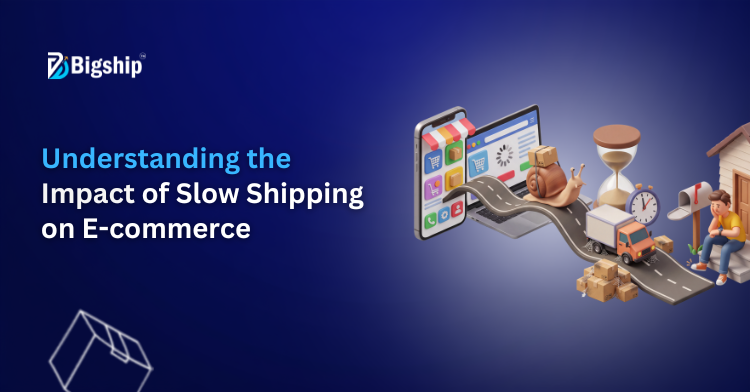
Despite businesses providing excellent quality goods and competitive pricing and an easy purchasing platform, slow shipping can influence a consumer’s shopping journey.
A customer may order a pair of shoes and expect them to be delivered within 3 days but if the delivery takes more than 3 days then the customer may form a poor view of a company, despite the goods themselves meeting expectations.

Companies can suffer from high cart abandonment, poor customer satisfaction and issues with brand perception. Furthermore, consumers can readily switch from one brand to another that provides more efficient delivery services.
Alongside swift delivery, it is therefore crucial for e-commerce companies to ensure delivery services are efficient, cost-effective and well communicated.
How Slow Shipping Impacts E-commerce Sales
Although the act of shipping is frequently the last part of a customer’s shopping process, it can also impact on a range of areas including, consumer behaviour, sales and business progression.
Below are 6 ways slow shipping can affect an e-commerce business.
1. Increased cart abandonment
Consumers can decide not to complete their purchases if they discover that items will take a long period of time to be delivered.
Two companies selling equivalent goods at similar prices may see customers favour the store which states that it can deliver within 3 days, compared to a rival which takes 7 days.
Hence, slow shipping can prevent consumers from completing their purchases, thereby lowering a firm’s conversion rate.
2. Low customer satisfaction
Consumers expect goods to be delivered within the specified timeframe. Small discrepancies in this area can create dissatisfaction, particularly if businesses do not effectively communicate a customer’s order progress.
If businesses fail to provide regular updates, consumers can worry about their orders and doubt a brand.
Precise delivery information and good communication are key in sustaining good customer satisfaction.
3. Poor customer retention
While money must be spent on marketing in order to gain new customers, customer retention is highly influenced by a person’s shopping experience.
Poor shipping efficiency can cause consumers to lose faith in a business and so move to a rival which provides more efficient delivery services.
Despite strong marketing and appealing deals, a lack of good delivery service can prevent a consumer from returning to a brand.
4. Unfavourable brand image and perception
Companies can face bad publicity related to their brand if goods are not delivered within the promised timeframe. This can be seen through negative product reviews, social media posts and general customer feedback.
Even if a product is well received by a consumer, they may still post a bad review for a brand should it not arrive on time.
Such comments can then affect other prospective customers and create further challenges for a company in establishing itself as a credible brand and in gaining new consumers.
5. Reduced conversion rates and sales
Consumers can be discouraged by slow shipping, particularly if they require goods by a particular date.
If rival companies consistently provide quicker and more efficient delivery services, customers may opt to shop at these businesses.
Furthermore, disgruntled customers are often less inclined to make additional purchases. Thus, a company can suffer in both its sales and in the value of its customer base.
6. Increased customer service demand
Common questions raised by consumers regarding slow shipping include:
- Where is my order?
- Why has my order not yet been dispatched?
- When will I receive my goods?
- Has my delivery date altered?
As a consequence, staff within a company’s customer service department can become heavily occupied in responding to numerous shipping-related customer concerns. Consequently, there is less capacity for them to deal with other customer issues.
This can raise customer service expenditure and further strain a business.
What are the Common causes of shipping issues
While sometimes issues do stem from a business’s couriers, more often they arise from a company’s order, stock and storage processes.
Analysing a company’s processes can therefore pinpoint areas for improvement and enhance delivery times.
1. Problems in Order fulfilment
Checking, selecting, packing and labelling stock all contribute to the order fulfilment process. If there is poor communication and/or a high level of manual labour involved in this, then it can cause delays and cause stock to remain in a company’s warehouse for longer.
Such issues can be exacerbated during busy trading times.
2. Issue in Stock control
Incorrect stock data can cause a business to fulfil orders for out-of-stock items. This can then cause late deliveries, back-orders and/or order cancellations.
Furthermore, if a business operates on more than one platform then a lack of up-to-date and shared stock data can further hinder a company’s stock control and order fulfilment.
3. Incorrect courier selection
Couriers differ in terms of speed, area of operation and cost.
While a courier may provide good service in urban regions, it may not do so effectively in more rural areas. Similarly, focusing purely on a courier’s cost can often lead to regular shipping delays and unsuccessful collection attempts.
Appropriate couriers should be selected based on a company’s desired delivery requirements and service expectations.
4. Problem in Last-mile Delivery
Last-mile delivery refers to the transfer of goods from a nearby storage facility to a customer’s address.
Obstructions such as heavy traffic, wrong addresses, restricted access to a property and ineffective delivery routes can all affect last-mile. Even if goods successfully arrive in the correct city, last-mile delivery issues can still impact upon delivery times.
5. Heightened order levels
Orders often spike around particular times of the year (for example at festive times, throughout certain seasons and during key shopping events).
This can create added strain on both a company’s storage and courier services. If not managed effectively, a business may face order build-up, late order fulfilment and protracted delivery times.
6. Absence of live shipment data
Customers typically desire the ability to follow the progress of their orders and obtain correct delivery information. Without live shipment data at its disposal, a business may find it difficult to recognise and then clearly convey any shipping delays.
Additionally, without live data a company may find it hard to detect which shipments are delayed at storage facilities and/or recognise persistent delivery issues.
Live data allows companies to observe shipments, recognise possible issues and implement solutions to avoid worsening shipping delays.
How to reduce shipping problems
While external factors such as weather and transport can sometimes be beyond a business’ control, there are measures which can be used to reduce preventable shipping issues and boost delivery performance.
Selecting good quality couriers
Businesses should consider the following aspects of potential couriers:
- Delivery punctuality.
- Collection and dispatch lead times.
- PIN code availability.
- Pricing and extra costs.
- Returns capability.
- Support and problem-solving facilities.
Combining good pricing with reliable couriers will aid in ensuring timely delivery.
Warehouse and fulfilment best practice
Categorising stock within a warehouse according to product popularity can boost a business’ dispatch performance. In addition, using barcoding, uniform packaging and defined dispatch procedures can assist in reducing errors.
Working with more than one courier
While it can be restrictive to rely on just one courier, diversifying your options means that businesses can choose appropriate couriers for specific areas, desired delivery speed, and levels of and costs of service provision.
It also enables businesses to switch to an alternative courier if a selected courier has problems or is at maximum capacity.
Real-time shipment monitoring
Businesses can compile data in one place detailing the status of goods shipped via various couriers. This assists in recognising and then resolving shipping issues and observing the progress of shipments.
Such data can additionally be relayed to customers through SMS, e-mail and/or WhatsApp.
Automating shipping and fulfilment
Automation can be employed to label, assign and amend shipment details as well as despatch orders – all with reduced human intervention.
Shipping automation criteria can then also be established relating to delivery destinations, product weight and delivery needs. This can further enhance effectiveness and cut errors.
Enhancing final mile delivery
Good address checking, delivery guidance and delivery time estimations can all contribute to better final mile delivery.
Analysing unsuccessful delivery events, wrong addresses and occasions where recipients are not available can also aid in cutting down on shipping issues and the number of RTOs.
Engaging with customers
Good communication is key to setting and managing customer expectations. Businesses should communicate effectively regarding order confirmation, dispatch, shipment tracking, and ‘out for delivery’ status.
Alerting customers to new delivery dates can also help to reduce uncertainty and lower the volume of customer service enquiries.
How to boost business using fast shipping
As well as allowing for quicker product delivery, fast shipping can also enhance customer relationships and brand reputation and can even boost sales for an online business.
Below are some of the ways that fast shipping can support an online business’ development.
Enhanced customer experience
Customers value it when they receive goods within the agreed timeline. Furthermore, a seamless order and delivery process is favourable for customers.
When deliveries can be made reliably, it also enables customers to feel more confident in ordering from an online business.
Higher conversion rate
Online business’ shipping policies can affect customers’ purchasing behaviour.
Providing sensible delivery timescales, together with varied shipping methods and clear delivery information can all support customers in deciding to buy.
Nevertheless, businesses should avoid overstating their delivery timeframes. An assured three-day delivery timeframe is preferable to a promised next-day delivery that is frequently missed.
Increased customer loyalty and sales
Alongside other benefits, a good delivery experience can further motivate customers to continue to order from a particular online business.
Despite paying more than rival businesses, 65% of consumers would still reorder from a company which provided an excellent delivery experience, as shown in Bringg’s 2026 Delivery Experience Study.
Therefore, good shipping can support not only a business’ customer loyalty, but also further sales.
Greater brand reputation
Successfully delivering goods in line with timeframes can establish a business as a trustworthy entity.
Consumers are more inclined to trust an online business if it can both accurately state delivery timescales and then successfully fulfil them.
A good brand reputation can also encourage referrals and positive word-of-mouth, helping a business attract new customers.
Streamlined business processes
While quick delivery can be favoured by customers, this need not require a company to incur high shipping costs.
Through optimising a business’s warehousing, utilising automation, and identifying appropriate couriers, unnecessary operational steps can be minimised.
Goods can then be ordered and managed more effectively and businesses can effectively control the relationship between delivery speed and cost.
How to Choose the Right Shipping Solution for Your E-commerce Business
It is crucial that an online business identifies the most appropriate shipping solution so that it can continually deliver well as it develops. Ideally, a shipping solution will assist with order handling, courier comparison and general shipping oversight.
Consideration should be given to the following:
Comparing courier services and their delivery performance
Identify a shipping solution which allows businesses to access a range of couriers and their differing delivery provisions.
Investigate the performance of various couriers in key areas that your business ships to. Assess whether they can deliver reliably to urban areas, as well as smaller towns and more outlying PIN codes.
Having access to a variety of couriers therefore affords greater choice for businesses.
Analyzing shipping costs
Shipping costs will clearly affect a business’ bottom line. Yet, although it can be tempting to consistently opt for the most economically priced courier, this may not always be advisable.
Compare courier costs alongside supplementary shipping expenses. Also analyse differences in weight and any other relevant charges.
An ideal shipping solution will allow a business to effectively combine good delivery performance with cost effectiveness.
Monitoring and automating
Shipping solutions should enable businesses to monitor and automate components of their shipping.
Ideal functionality includes the ability to:
- Monitor order progress.
- Automatically match orders with appropriate couriers.
- Print shipping labels.
- Receive order and delivery alerts.
- Handle non-delivery reports (NDRs).
- Access shipping and delivery data and reports.
Such functionality can streamline a business’ shipping procedures and can also identify possible shipping related issues.
Assessing scalability and customer service
As an online business develops, so too may its shipping needs. For example, the shipping solution which was appropriate for a business at 50 orders per day may not be adequate for one which then begins to handle thousands of orders.
Therefore, it is important that a business can scale its shipping solution in a manner which does not unnecessarily complicate its functioning.
Excellent customer service is also integral. Prompt customer service can often assist in overcoming shipping concerns and in managing business issues, and so can help to avoid business interruptions.
Bigship, for example, assists online businesses to optimise their shipping by providing multi-courier integration, automated courier matching, monitoring, NDR handling and shipping data. This allows businesses to centrally oversee their shipping needs and further enhances both shipping oversight and control.
Conclusion
As well as impacting delivery speeds, slow shipping can therefore affect conversion rates and customer satisfaction. Although there are external reasons for shipping delays, businesses can take steps to improve their shipping operations. This can be achieved by improving order handling, managing stock and selecting suitable couriers. Alongside these methods, implementing automation and offering tracking facilities can further enhance shipping efficiency and visibility.
While speed is often seen as a key area to focus on, it is important to also ensure that goods are delivered within the promised timeframe and reliably. An effective shipping solution, along with associated technology, can aid a business in developing customer trust and supporting its growth.
FAQs
Alongside increasing cart abandonment and decreasing customer satisfaction, slow shipping can also put off customers from buying from a company. Further, it can result in poor customer feedback and hence impact on both conversion and sales.
Quick shipping is important as it enables a business to better satisfy its customers and enhances the customer experience. As highlighted above, alongside speed, dependable shipping and clear timescales are also key.
Customers can become dissatisfied when shipments are late. Particularly if they are unaware of where their goods are in the shipping process, this can even cause customers to lose trust in a business and put them off future buying.
Yes. Customers may decide to remove items from their shopping basket if they feel that the delivery timescale is not in line with their expectations. Indeed, according to DHL’s 2026 E-Commerce Trends Report, 67% of online shoppers have left a basket due to a company’s delivery service.
Typical reasons for shipping problems can encompass ineffective order handling, poor stock control, untrustworthy couriers, last-mile delivery issues, high order levels during busy periods and poor tracking facilities.
Improving warehouse functioning, stock control, selection of suitable couriers and implementation of automation, as well as offering tracking information, can all help to alleviate shipping issues.